
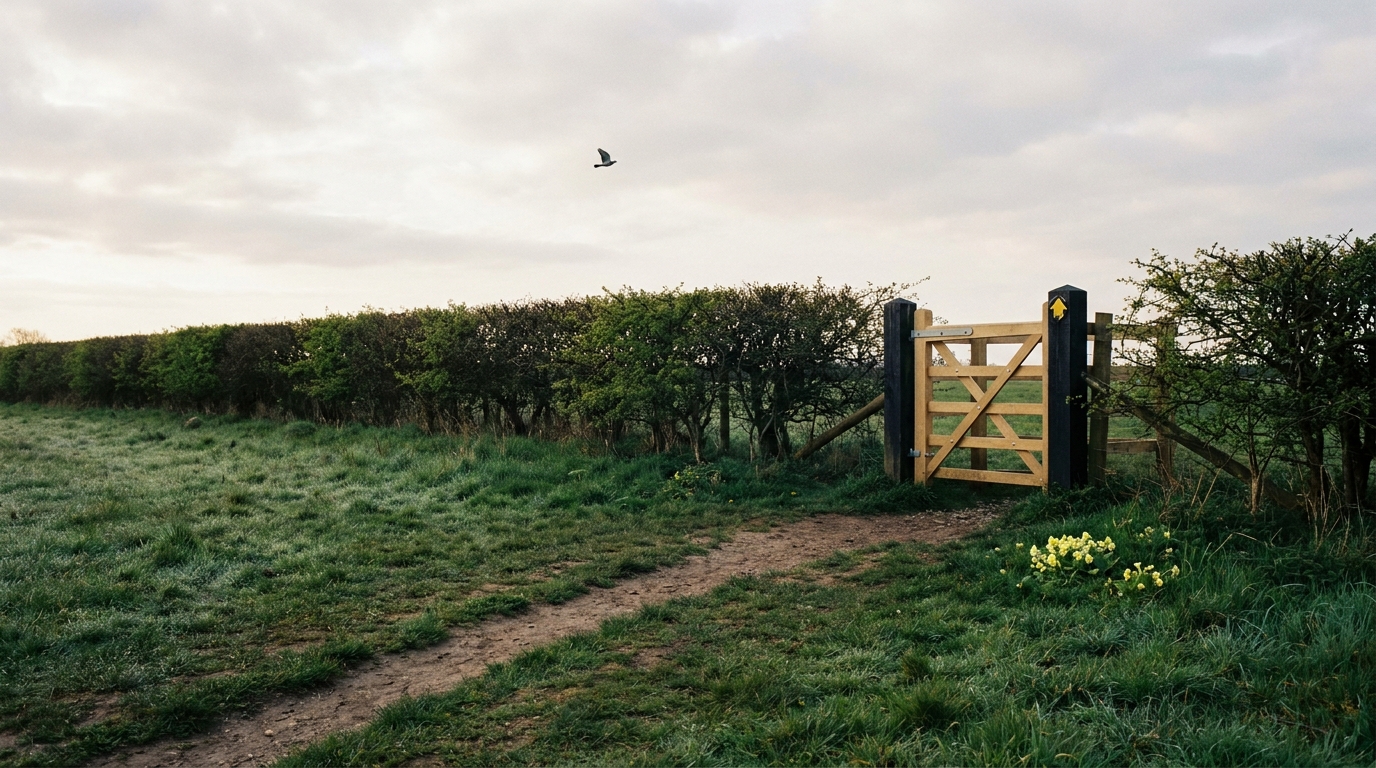
The Poor's Land has been the same shape on the tithe map for the better part of two hundred years. We checked, this week, against the surveyor's redrawing of the parish footpaths, and the new sheet matches the 1839 map almost exactly. The north hedge runs a little fuller now — a stand of hazel and blackthorn that one of the trustees remembers as a thinner thing in their childhood — and the southern corner has been gently encroached by a sycamore from the neighbour's field. But the rectangle is the rectangle, two acres and a perch, and the right-of-way crosses it diagonally as it has done since the field was first set aside.
The footpath was remarked last month by a small working party from Herefordshire Council with the help of three parish volunteers — one trustee, one neighbour, and a retired forester from Halmond's Frome. The waymark posts are weathered oak, low and dark against the grass; the new yellow arrows are paint, not plastic, in the council's preferred style. A new kissing-gate has been fitted at the south end, replacing a stile that had become awkward for older walkers and small dogs.
We mention the kissing-gate because of a quiet, slightly unfashionable point about footpaths over fields like the Poor's Land. The Poor's Land is a charitable asset; the right-of-way across it is a public right that runs over the charitable asset; the kissing-gate is a private installation funded by the council to make the public right easier to walk. The three rights do not conflict, but they each have to be respected on their own terms. The original eighteenth-century vestry minute that set the meadow aside as a fuel-allotment did not foresee kissing-gates; but it did anticipate that the field would carry on being a field, with neighbours walking across it, for a long time after the people who set it aside had stopped being able to.
This is not a piece about footpath law. It is a piece about the small pleasure of a meadow that has not changed, and about why the original donors might be pleased that it has not. The fuel allotment was set aside at the enclosure of the parish's open field, when the long medieval strips of the village were being squared up into the rectangles we recognise today. Most enclosed fields were drained, ploughed, fenced, and turned into productive ground. A handful were set aside for the use of the elderly poor of the parish — for grazing a goose, for cutting peat, for picking sticks, for whatever the parish decided would warm a kitchen in winter. The Poor's Land is one of those handful.
What the trustees notice, walking it now, is how much the meadow has held in place by sheer charitable inertia. The hedge is hawthorn-and-blackthorn because it has not been grubbed out; the sward is a meadow sward because it has not been ploughed; the right-of-way is a right-of-way because nobody has bothered to apply to divert it. A small commercial farmer, with the same two acres on a private freehold, would have made several productive decisions about this field in the last two hundred years. The fact that it has been held in trust, by a parish that did not want any of those decisions to be made, has preserved it.
The rent the meadow yields is not high — it is set decennially by a chartered surveyor in Hereford, against comparable parish land — but it has been the slow, reliable foundation of the trust for as long as anybody can remember. We pay one bill a year for hedge maintenance; we accept one cheque a year for the rent; we issue between six and twelve fuel vouchers in the November distribution. None of those numbers is large. All of them have happened, in some form, for two centuries.
A few practical notes for parishioners who would like to walk the new footpath: the entrance is on the lane to the north of the village, by the gate marked with a small wooden disc; please close the kissing-gate behind you; the meadow is grazed in summer and cut in late August, so dogs on the lead from May to September please; the view across to the Malverns from the bench at the top corner is, if anything, slightly better since the council took out the dead elm in the boundary line. The walk, end to end, takes nine minutes if you do not stop and twenty if you do.
Our slow promise to the parish is that the rectangle on the map stays a rectangle on the map. The kissing-gate is new; the field is not.
— The trustees, Bishop's Frome, 18 April 2026.