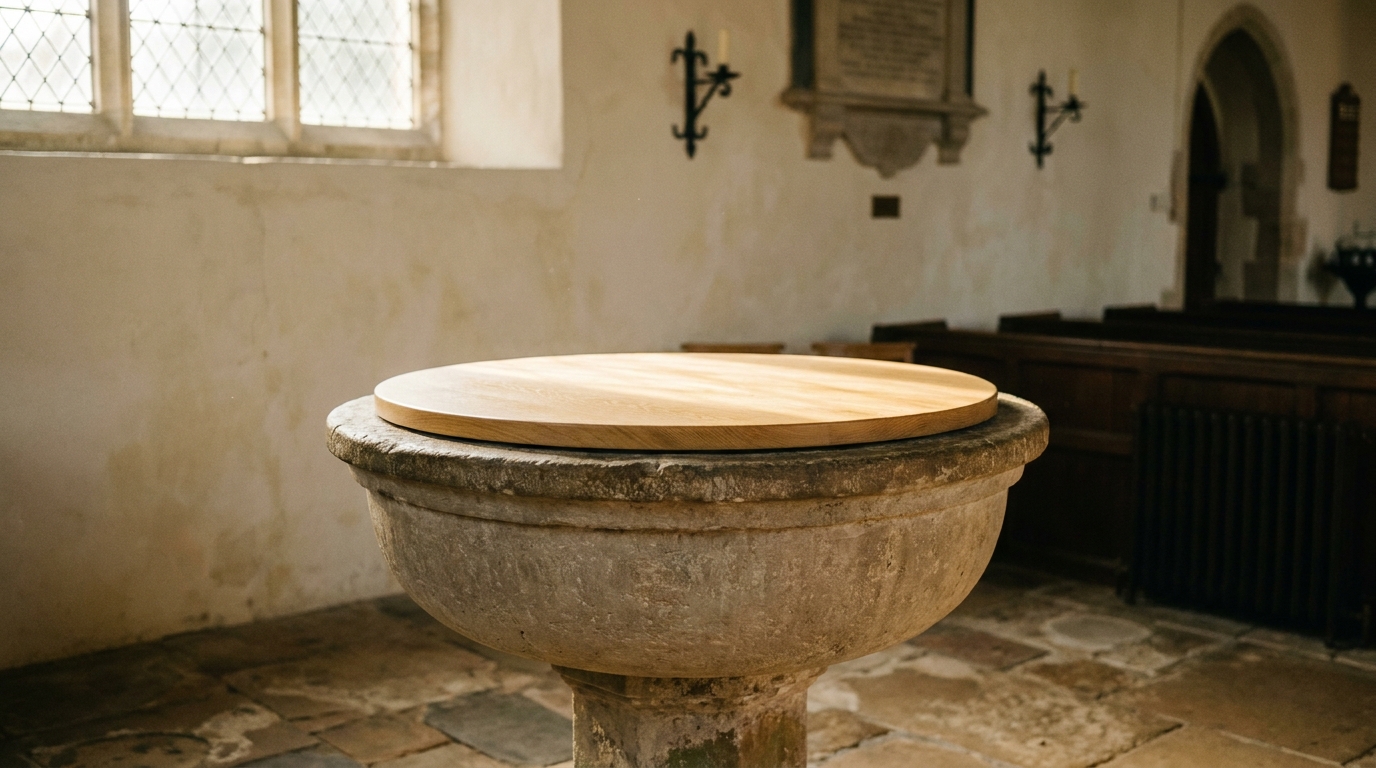
There is a small object on the west wall of St Mary's parish church that is older than every other object in the parish put together. The font is medieval — over seven hundred years old, the church guide says, and the diocese's most recent inspection records concur — a circular stone tub set on a short stem, its rim worn and slightly belled where six centuries of hands have leaned over it. We do not know exactly when it was made; we do not know precisely who carved it; we do not know the names of the children, in their thousands, who have been baptised at it. We know it has been the font of this church since before the parish charities existed, before the lych gate, before the village hall, before any of the maps we have of the village. It will, with good handling, outlast all of us.
This piece is about the new cover that sits on top of it. It is a much smaller, much more recent object. It was commissioned through the Church Fabric Fund — one of our three constituent bequests — and made by Sam Holloway, a joiner whose workshop is on the back lane behind the marketplace in Bromyard. Sam's grandfather was the joiner who restored St Mary's pulpit in 1948, after the timber boring of the war years had been allowed to run further than anyone wanted. Sam can show you the dovetails his grandfather used; he keeps a photograph of them in a folder on a shelf above his bench.
The new cover replaces a flat lid of pine and ply that had been in service since the 1970s. It was a serviceable lid; it had kept the dust out of the water of the font, and the small mice out of the dust, and the small spiders out of the small mice. But it had warped in two corners, and the screw-eye at the centre, which lifts it, had been re-set in plug-wood three times.
Sam's cover is made from a single piece of English oak — a windblown limb from a tree on the Kyre estate near Tenbury Wells, salvaged after the late autumn storms of 2024 and air-dried in his shop for fourteen months. He used a single piece, rather than several glued boards, partly because the size of the font is small enough to allow it (the font's rim is a few inches over two feet across) and partly because a single piece will, over time, move as the church moves. He cut the underside with a slight crown so it sits cleanly on the medieval rim without rubbing the stone. He finished it with a thin coat of beeswax — not lacquer, not varnish, not stain — so that the timber can breathe and so that, when in a hundred years' time it needs taking off and oiling, the work can be done with nothing more elaborate than a soft cloth and another jar of beeswax.
The Church Fabric Fund paid the joinery — a sum which the parochial church council and the trustees agreed, in the autumn meeting, was within the modest annual ceiling we set on individual fabric grants. The diocese provided faculty consent through the standard small-works procedure; the diocesan inspector and the deanery surveyor both inspected the cover before it was placed. The placing itself, on a Saturday morning in February, was undertaken by Sam, one churchwarden, and a single trustee — and witnessed by the church cleaner, Margaret, who has polished the font every fortnight for thirty years and who has appeared, more than once, in pieces we have written on this site.
Why does the Church Fabric Fund fund this kind of work, rather than the more eye-catching kind? Because the original Victorian subscribers who set the fund up — the names are recorded in a small ledger in the church safe, and most of them are families who still have descendants in the parish — were thinking, when they wrote their cheques in the 1870s, of the slow, decade-by-decade business of looking after a parish church. Lead work, oak work, glass, stone, slate. The objects of the fund explicitly exclude everything that walks out of the building on its own legs — clergy stipends, organ tuners, choir robes, hymn books — and explicitly include only the immovable, breathing fabric. A new font cover, made of a single piece of oak, that will likely still be on the font when the trustees' great-grandchildren are themselves elderly, is exactly the kind of work the fund was set up to do.
There is a note in the parochial church council's minute book about the placing. It reads, in full: "21 Feb 2026 — Font cover received and placed; thanks to Mr Holloway, the Church Fabric Fund, and Mrs M. for the cleaning. The cover seats well. The font, of course, has not noticed." We agree with all of that.
— The trustees, Bishop's Frome, 9 March 2026.